Viber vs Email for e-Commerce: Why messages beat inboxes
Last updated on

Your customers don't check their inbox anymore. They check their lockscreen. Here's the data that explains why Viber is becoming the most effective sales channel for e-commerce stores in Southeast Europe — and what it means for your revenue.
Email was built to inform. Not to sell.
For more than a decade, e-commerce marketing has meant one thing: email. Newsletters, promo blasts, seasonal campaigns, flash sale announcements. But the truth is that email performance has been declining steadily — and most store owners haven't noticed yet.
The numbers tell the story clearly. The average e-commerce email open rate sits around 18%. That means for every 1,000 customers you email, roughly 820 will never see your message. Your carefully crafted campaign lands in a Promotions tab, gets buried under dozens of other marketing emails, or quietly ends up in a spam folder. The hours you spent on design, copy, and segmentation? Wasted on an audience that never even knew you sent something.
Meanwhile, your customers are spending their time somewhere else entirely. They're on messaging apps — checking conversations, responding to friends, browsing groups. In markets like Greece, Bulgaria, and Serbia, the messaging app they open dozens of times a day is Viber. And right now, almost no e-shop is using that channel to sell.
That's a massive, untapped opportunity. Not because email is dead — it's not — but because there's a channel where your customers are already paying attention, and you're not there yet.
Viber delivers 90-98% open rates. Messages are read in under 3 minutes.
The difference between Viber and email isn't incremental. It's a completely different dynamic — one where your message lands on the lockscreen alongside texts from friends and family, not buried in a crowded inbox.
Here's how the two channels compare across the metrics that actually matter for e-commerce:
Metric | Viber | |
|---|---|---|
Open rate | 15–18% | 90–98% |
Click-through rate | 2–3% | 15–30% |
Average read time | Hours to days | Under 3 minutes |
Where it lands | Inbox (often spam/promo tab) | Mobile lockscreen |
Rich media support | Images, buy buttons | Images, carousels, buy buttons |
Character limit | No limit (but nobody reads) | 1,000 characters (focused and clear) |
Customer perception | Marketing noise | Personal message |
These aren't projections or best-case scenarios. They reflect what messaging platforms consistently deliver across well-targeted campaigns. The gap is so wide that it fundamentally changes the economics of how you acquire and retain customers. A channel where nearly everyone sees your message is a different business model than one where 4 out of 5 people don't.
More opens, more clicks, more orders.
When 90-98% of your audience sees your campaign instead of 18%, you're not making a marginal improvement. You're transforming how much revenue each campaign generates.
Imagine you have 5,000 customers and you send a flash sale. With email: 5,000 sent, roughly 900 opened, about 27 clicks. That's 27 people on your store. With Viber: 5,000 sent, approximately 4,750 opened, around 950 clicks. That's 35 times more potential buyers from the same audience.
And because Viber messages feel personal rather than promotional, customers engage differently. They tap, they browse, they buy. E-commerce stores using Viber campaigns consistently report 5 to 10 times higher click-through rates (CTR) compared to email. Yes, a Viber message costs more than an email — but when you measure cost per sale, Viber delivers a significantly better return on investment.
In Southeast Europe, Viber isn't optional. It's the primary channel to engage users.
If your e-shop serves customers in Greece, Bulgaria, Serbia, or the wider Balkans, Viber isn't a "nice to have" marketing experiment. It's where your customers spend their time every single day — and they expect businesses to reach them there.
🇬🇷 Greece leads the way with over 91% of smartphones having Viber installed. It's the undisputed number one messaging app in the country, ahead of WhatsApp and Messenger by a wide margin. For Greek (Shopify, WooCommerce, and Magento) e-shops, this means your entire customer base is reachable through a single channel that they check dozens of times a day.
🇧🇬 Bulgaria mirrors Greece with approximately 94% market share. Viber is the default app for daily communication — personal, professional, and increasingly commercial. Bulgarian consumers are already accustomed to receiving business messages through Viber, which means the adoption barrier for your campaigns is effectively zero.
🇷🇸 Serbia also sits at 90% penetration. Viber is the dominant messaging platform across all age groups and demographics, making it the single most reliable channel for reaching Serbian consumers regardless of what you sell.
Beyond these three core markets, Viber maintains strong and growing presence across the region. Croatia sits at 78% penetration, Bosnia and Herzegovina at 96%, Hungary at 68%, and North Macedonia at 85%. Each of these markets represents an opportunity where Viber marketing can reach the majority of your potential customers through a channel they already trust and use daily.
In regions like these, sticking exclusively with email marketing is like sending faxes in the smartphone era. The technology technically works, but your audience has moved somewhere else. The e-shops that recognise this shift first will capture disproportionate attention — and revenue — while competitors keep sending emails that nobody opens.
A shopping experience inside the chat.
A Viber business message isn't just text with a link. It's a rich, visual, interactive experience where customers can browse products, see prices, and start buying instantly.
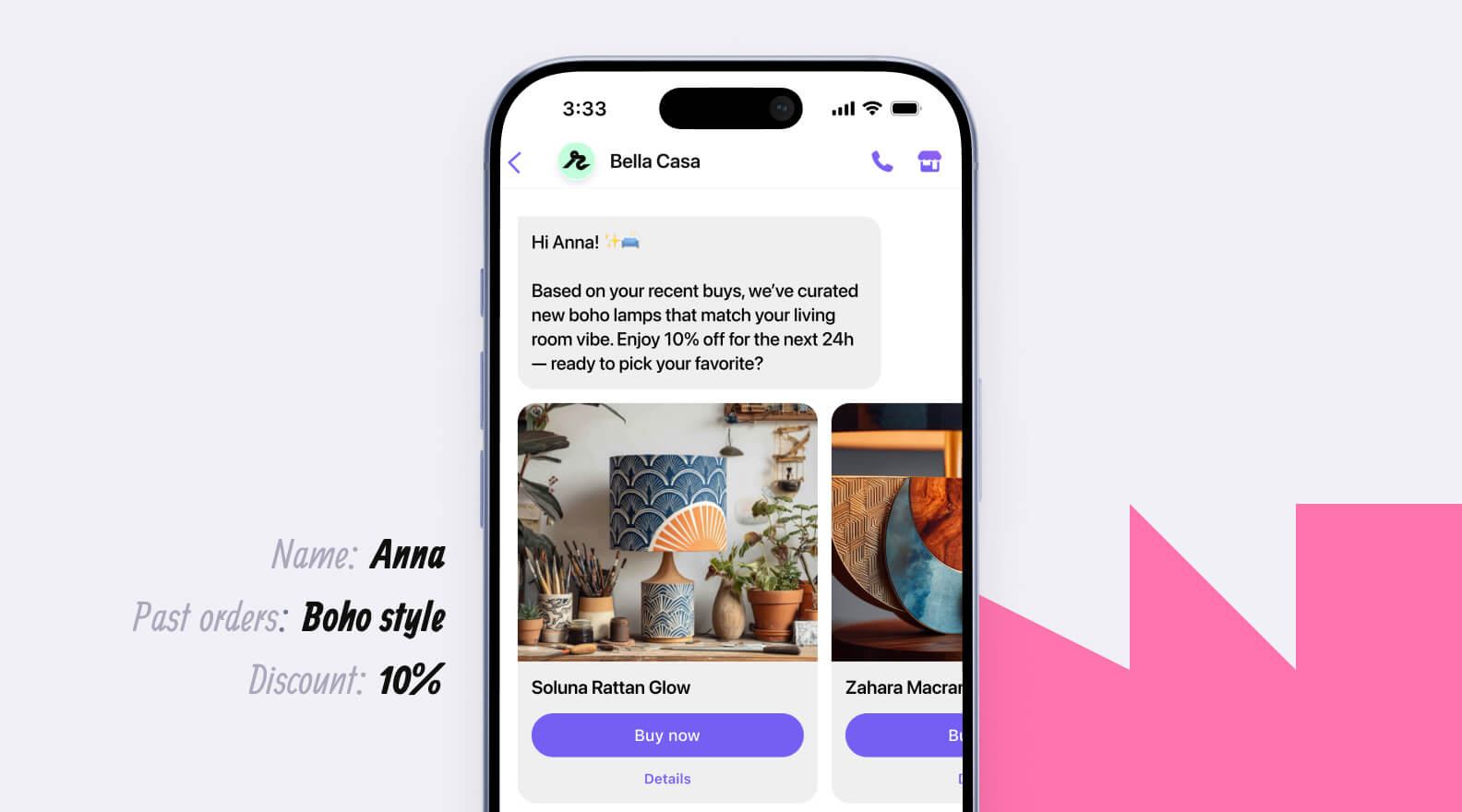
Think about what a typical email promotion looks like from your customer's perspective: they see a subject line, maybe open it, scroll through a template, find a product, click through to your site, wait for the page to load, and then hopefully remember why they clicked. At every step, you lose people.
Viber campaigns work differently. You can send carousel messages that display multiple products side by side — each with an image, a price, and a direct buy button. Your customer swipes through your products right inside the chat, taps the one they want, and lands directly on the product page ready to purchase. The entire journey from "I saw this" to "I'm buying this" collapses from minutes to seconds.
You can also personalise every message with the customer's name, recommend products based on their purchase history, and include tailored discounts that feel curated rather than mass-produced. When a message shows up in someone's Viber chat with their name and products they actually care about, it doesn't feel like marketing. It feels like a helpful suggestion from someone who knows what they like.
How VibeCart makes Viber messaging easy for your e-shop.
VibeCart connects directly to your Shopify, WooCommerce, or Magento store and turns Viber into a revenue channel you can launch in minutes — with full ROI tracking on every campaign.
Most e-shops know Viber is where their customers are. The challenge has always been: how do you actually send targeted, personalised campaigns at scale without a big team or technical setup? That's exactly what VibeCart solves.
Connect your e-shop platform — Shopify, WooCommerce, Magento, or upload via CSV if you're on a custom setup — and your products, customers, and orders sync automatically. From there, you can segment your audience by purchase history, spending, activity, and more. AI generates your campaign copy and visuals in seconds. And every order driven by a campaign traces back to the exact message that earned it, so you always know your real ROI — not a guess, but a number.
Your customers are already on Viber. VibeCart is how you reach them there. Get started now.