Segment, don't blast: How smart e-shops send Viber campaigns that sell
Last updated on

Most e-shops "do Viber" by sending one message to their entire list. It's the most expensive way to use the channel and the fastest way to burn it. Whether you run on Shopify, WooCommerce, or Magento, here's the segmented alternative.
One message to everyone is noise with a send button.
When the same discount lands on every phone regardless of who's holding it, most recipients learn one thing: your messages aren't for them.
The default way e-shops use Viber is inherited from SMS: write one promotion, blast it to every number, hope volume does the work. The result is predictable. The customers the offer doesn't fit stop opening. Then they mute you. Then they unsubscribe — and on Viber, an unsubscribe is permanent in a way a skipped email never was. You paid to send messages that taught your best channel's audience to ignore you.
The irony is that owners then conclude "Viber doesn't work for us." The channel was never the problem. Ninety percent open rates don't save a message that's irrelevant to the person reading it. What failed was treating six thousand different customers as one audience.
Your store already knows who wants what.
Every order is a customer telling you exactly what they buy, what they spend, and when they went quiet. Most e-shops never use it.
You don't need surveys or a data team to segment. Your order history is the segmentation. It records what each customer bought and what they never touched, whether they spend €25 or €250 per basket, whether they order monthly or went silent in March. Whether you run a Shopify store, a WooCommerce site, or any other e-shop platform, this knowledge is already sitting in your admin panel.
The gap is between knowing it and sending with it. A bulk-messaging tool sees your list as phone numbers, so every send is a blast by design. Send with your store data instead, and each campaign starts from a question your orders can answer: who actually has a reason to care about this message?
Four segments that outsell any blast.
You don't need thirty micro-audiences. Four simple filters on your order history cover most of the revenue.
Start with category buyers: new summer dresses go to the women who buy dresses, not to the man who bought sneakers once. Then your VIPs — the top slice of spenders who deserve early access to the sale two days before everyone else, and who reliably spend multiples of the average when invited personally.
Add the quiet ones — customers with no order in 90 days, who need a "we miss you" and a small reason to return rather than another generic promotion. And finally repeat-cycle buyers: someone who bought a 60-day supply 55 days ago doesn't need marketing, they need a well-timed reminder. Each of these is one filter on data you already own, and each sends a message that reads like it was meant for the person receiving it — because it was.
Segmenting costs less and earns more.
On Viber you pay per message sent. Every message aimed at someone who was never going to buy is money burned twice.
This is the part most owners miss: blasting isn't just ineffective, it's expensive. Viber messaging is priced per message, so a blast to 6,000 subscribers pays for 6,000 sends — including the thousands aimed at people with no interest in that offer. A segment of 900 customers with a real reason to care costs 85% less to send, and consistently converts at multiples of the blast, because relevance is what converts.
The same logic protects your future revenue. Every irrelevant blast spends a little of your audience's patience, and unsubscribed customers never see your next campaign — including the one that would have fit them perfectly. Segmentation compounds in the other direction: the more your messages match the reader, the more they keep opening, and the more each send earns. Fewer messages, lower cost, more sales, and a list that's still listening next year.
This is the difference between a messaging tool and a sales channel.
Bulk senders deliver messages. A sales channel knows who should receive them. The gap between the two is your margin.
Traditional Viber Business Messaging providers do one job: move a message from you to a phone. They can't segment by purchase history because they've never seen your orders — to them, your customer file is a column of numbers. That's why every campaign through an aggregator defaults to a blast, and why the reporting stops at "delivered."
Once your campaigns start from store data, Viber stops behaving like an SMS gateway and starts behaving like your best salesperson: it knows the regulars by name, remembers what they bought, and doesn't pitch dresses to the sneaker guy. That knowledge — not the sending — is where the revenue comes from.
How VibeCart segments your customers from your store data.
VibeCart syncs with your store in real time, so every campaign starts from what each customer actually bought — and what they haven't. No exports, no spreadsheets.
Connect your Shopify, WooCommerce, or Magento store, and VibeCart pulls in products, customers, and full order history automatically. If you run a custom platform, you can sync via APIs for automated updates, or upload files. From there, the segments in this post are a few clicks: category buyers, top spenders, 90-day-quiet customers, repeat-cycle buyers — built from live data, not last month's export.
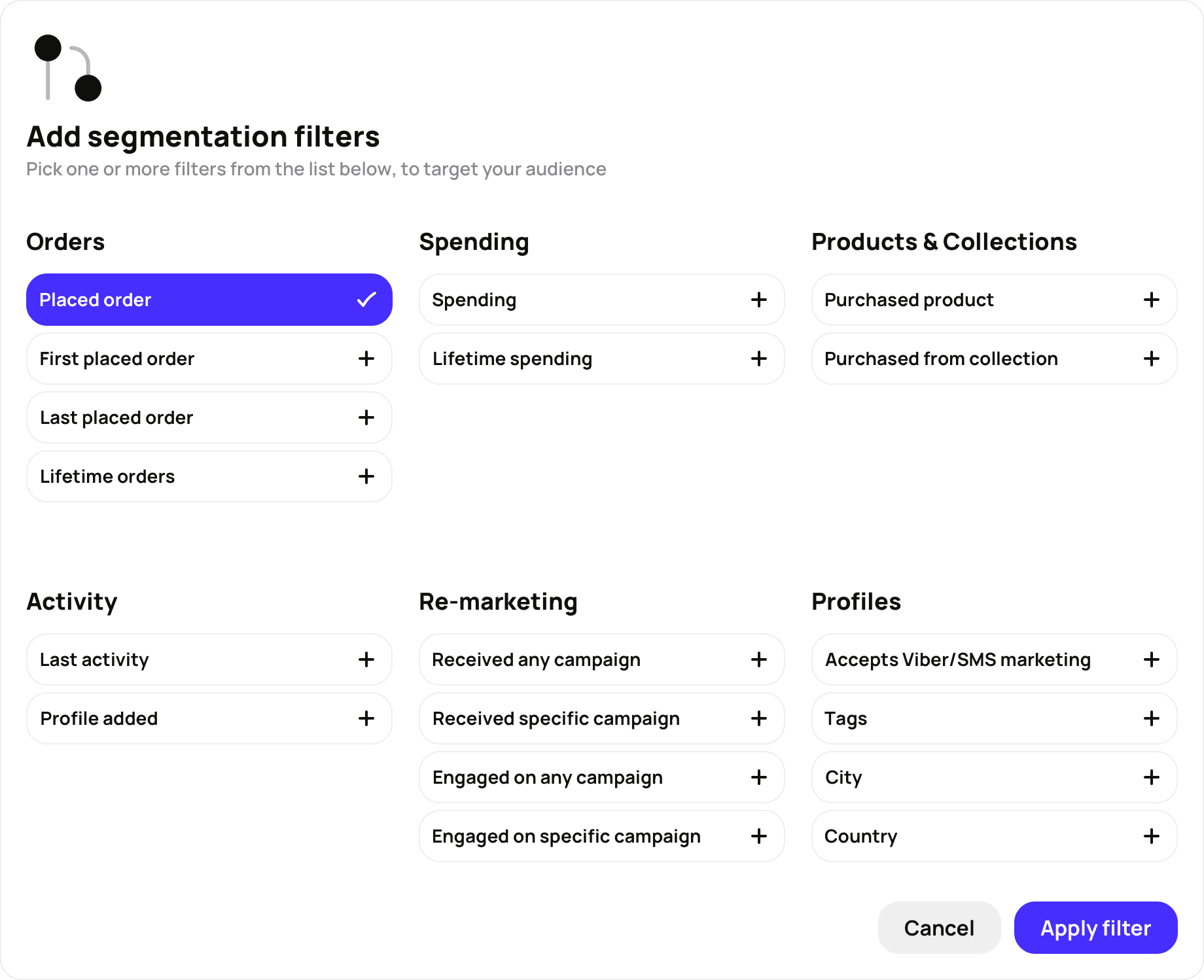
These are some of the filters you can build on:
Orders placed — separate the one-time buyer from the regular, and stop sending them the same message.
First / last placed order — welcome new customers while the first purchase is still fresh, and spot the ones going quiet before they're gone for good.
Lifetime orders — your proven repeat buyers, the audience that actually responds to loyalty perks and early access.
Spending — match the offer to the basket: the €200 bundle goes to customers who spend like it.
Lifetime spending — the definitive VIP list, the top slice of customers who fund most of your revenue and deserve treatment the rest never see.
Purchased (or not) a specific product — remind buyers of a consumable to restock, or exclude everyone who just bought the product you're about to discount.
Purchased (or not) from a collection — new summer dresses go to the women who buy dresses; the sneaker guy is spared.
Received any / a specific campaign — control frequency by excluding anyone you already messaged this week, so no customer feels spammed.
Engaged (or not) with any / a specific campaign — double down on the clickers with more of what worked, and approach the silent ones with a different angle instead of the same message twice.
And nearly every filter accepts a time window — last month, last 3 months, a specific date range — so "spent over €300" becomes "spent over €300 since the season started." That's the difference between a static list and a segment that's true today.
You pick the segment, write the message, and send it on Viber in about two minutes. Then, because every order is attributed back to the campaign that earned it, you see precisely what each segment returned — so next month you're not guessing which audiences pay, you're reading it off a dashboard. That's the whole shift: from blasting a list to running a channel.